
Underfloor heating milled in
any floor.
Vloerverwarming Arnhem mills the underfloor heating straight into your existing screed — without losing height, low-dust and neatly finished.
We'll call or email you within 2 hours with a price.
Milling underfloor heating into any screed
Every floor calls for its own approach. Whether you have a sand-cement or anhydrite screed, concrete, tiles, dry-screed boards or a wooden floor — we know how to get underfloor heating milled into it. See what applies to your situation.
Milling in sand-cement
The most common screed (anhydrite too). Ideal for milling, with even heat distribution.
More about sand-cement→ Hard & strongMilling in concrete
A strong, hard floor. With our heavy milling machines we cut the channels neatly and precisely.
More about concrete→ Dry constructionMilling in Fermacell & Knauf Brio
Gypsum-fibre dry screed. It calls for precision — we mill to exactly the right depth.
More about Fermacell→ No demolitionMilling in tiles
Yes, milling through tiles is possible too. No demolition — your existing tiled floor stays largely intact.
More about tiles→ Dry build-upWood as subfloor
On a wooden subfloor we don't mill into the wood itself. We fit Fermacell or Knauf boards and mill the pipes into those.
More about wood as subfloor→Not sure which floor you have?
No problem. We assess your situation and advise the best milling method.
Ask for advice →Straight through concrete — neat and low-dust
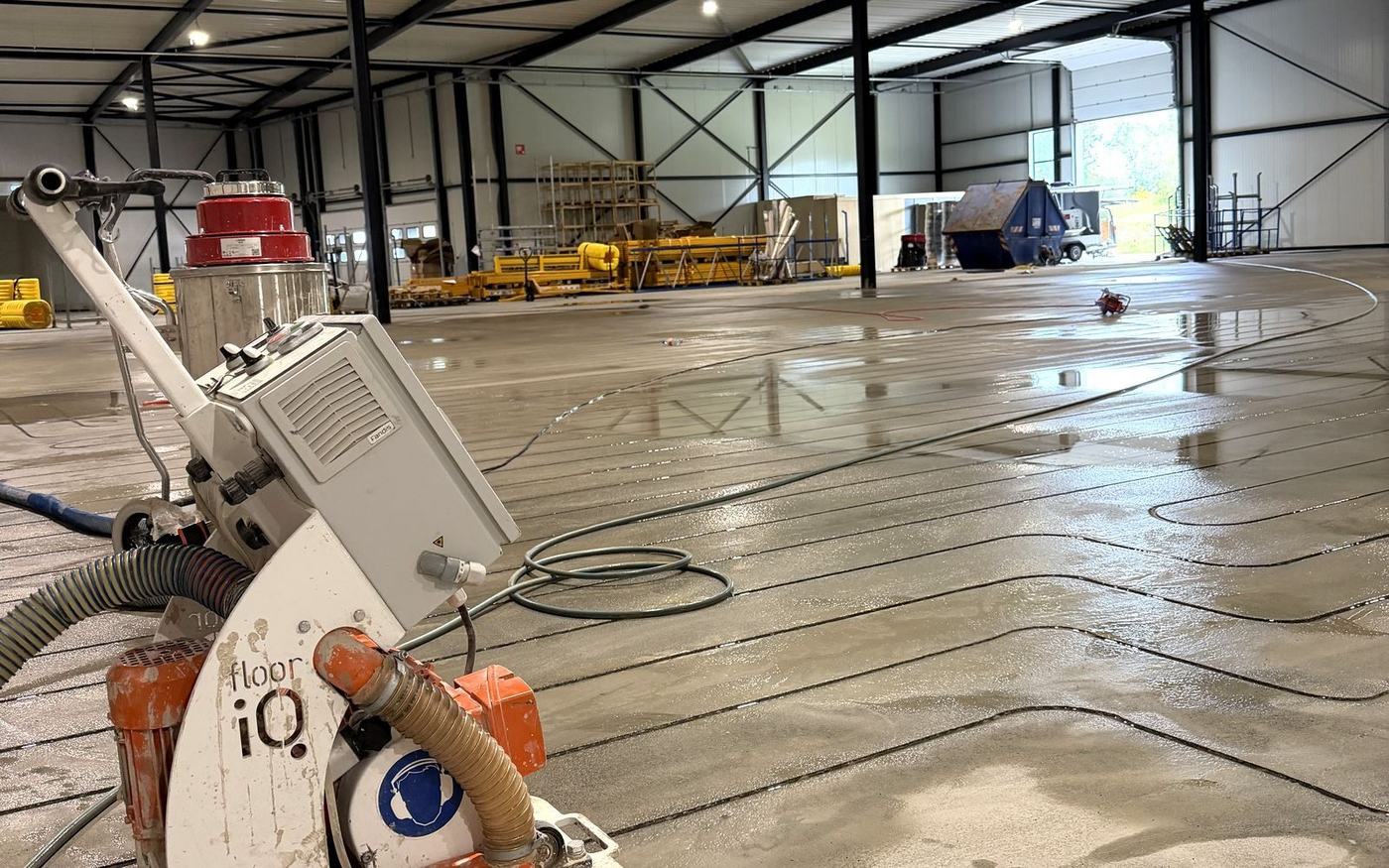
We mill the pipes into hard concrete floors with ease too. In this industrial hall in Bunnik — around 1,650 m² of blue concrete — we wet-milled 50 circuits, with water and special concrete diamond blades, straight through the concrete. The gravel in the floor becomes clearly visible.
- Suitable for concrete — even the hardest screeds.
- Precise, clean channels at an exact depth.
- Suitable for large areas and commercial premises.

The smartest solution for an existing floor
Having underfloor heating milled in is the way to install it in an existing home without demolishing your floor. The pipes go straight into the existing screed — with no added build-up height.
- No loss of height — doors and thresholds don't need adjusting.
- Low-dust work — modern milling machines with direct dust extraction.
- Fast heat output — pipes sit just below the surface.
- Often within a day finished and walkable again.
Self-propelled & low-dust milling
We work with a professional, self-propelled FloorIQ milling machine. Powerful enough for concrete and precise enough for a clean finish — with direct dust extraction so your home stays clean.
- Powerful motor — mills effortlessly through any screed.
- Direct dust extraction — low-dust work with direct extraction.
- Precise channels — an exact depth for optimal placement.

From request to a warm floor
In three clear steps — no surprises.
Free advice consultation
You tell us about your floor and wishes. We determine the best milling method.
A clear quote
A clear, tailored price, with no small print.
Milling & installation
Our team mills and installs the underfloor heating expertly, often in a single day.
Underfloor heating in a new screed
New build, extension or a new screed? Then nothing needs milling: we install the underfloor heating before the screed is poured — stapled, tied on mesh or on studded panels. You choose, we advise what suits your floor.

Stapling
The pipes are fixed to the insulation with tacker clips. Fast, free layout — then the screed is poured.
More about staplingView→
Tying on mesh
The pipes are bound to galvanised steel mesh with ties. Rock-solid — for homes and industrial halls alike.
More about tying on meshView→
Studded panels
The pipe is pressed between the studs of the insulation panel. Exact spacing, insulation and fixing in one.
More about studded panelsView→We take care of the plumbing too
Fitting the manifold and connecting it to your boiler, heat pump or district heating — including filling, pressure testing and balancing. Even if someone else installed the heating.
What customers say about us
Goede prijs
Wij hebben dit weekend onze vloerverwarming laten infrezen in Arnhem. De monteur was netjes op tijd en heeft de complete vloerverwarming inclusief montage al voor 13:00 uur afgerond, en dat zonder koffie!
Zeer tevreden met het eindresultaat en zeker een aanrader!


Onlangs een huis gekocht in Arnhem en meteen besloten om vloerverwarming te laten infrezen. Alles was snel geregeld en de monteur werkte netjes en professioneel. Binnen één dag lag de complete vloerverwarming erin. Superblij met het resultaat, een met de mooie start in ons nieuwe huis!

Top werk geleverd! Goede communicatie, komen afspraken na en denken met je mee. Alles is netjes en volledig naar wens uitgevoerd. Zeker een aanrader!

We hebben onze zandcement vloer laten infrezen door VloerverwarmingArnhem en het is nog beter verlopen dan gedacht.
Onze hele woning in Arnhem gefreesd in 2 dagen. In totaal 300m2, dat vond ik best knap.
Kort gezegd snel geregeld alles duidelijk en een mooi eindresultaat.
Erg blij met het resultaat maar vooral met de service! Zeer vriendelijk en precies zoals afgesproken.

Ares did the milling and install for my underfloor heating and did an amazing job! He taught me so much, communication was great, price was great, and the job is perfect. In less than 1 day the whole job was done for my whole apartment, I highly recommend!!
Zeer tevreden over de vloerverwarming. Strak en netjes ingefreesd. Zeker een aanrader! En nog bedankt voor het broodje! 😊

Afgelopen week vloerverwarming laten infrezen in onze woning in Amersfoort. De monteur was netjes op tijd en ging meteen aan de slag. Alles was sneller klaar dan verwacht en het werk ziet er keurig uit. Erg tevreden met hoe alles is verlopen!
Wij zijn erg tevreden over de service van dit vloerverwarmingsbedrijf. De werkzaamheden zijn keurig op tijd afgerond en alles is professioneel uitgevoerd. Er werd netjes gewerkt en na afloop is alles schoon en opgeruimd achtergelaten.

Snel en zeer degelijk! Bij ons moest de vloer gefreest worden en vloerverwarming worden gelegd en dit was allemaal zo klaar. Sneller dan verwacht en de vloer is heerlijk warm!
Fijne communicatie en zeer net werk afgeleverd! Ze denken ook graag met je mee. Prettige samenwerking gehad!
Reviews in the customer's original language.
Our underfloor heating projects
Browse our completed projects and see how we have fitted underfloor heating in spaces across the Netherlands. Click a project for a larger view.


Frequently asked questions about milling in underfloor heating
The most common questions about milling in underfloor heating. Can't find your question? Feel free to get in touch.
Can underfloor heating be milled into any floor?
In most existing floors, yes: sand-cement and anhydrite and concrete are suitable, and often tiled floors laid in cement too. The floor must be flat and sturdy enough. If in doubt, we inspect it beforehand.
How much height do I lose with milling-in?
Virtually none. The pipes go into the existing screed, so your floor doesn't get any higher. Doors and thresholds don't need adjusting.
How long does it take and can I walk on it straight away?
Many projects are milled and connected within a single day. After the channels are filled the floor is usually walkable again soon; we discuss the schedule beforehand.
Does the milling create a lot of dust?
We mill with direct dust extraction, so we work low-dust. Your home stays clean.
Does underfloor heating work with a heat pump?
Yes. Milled-in underfloor heating runs at a low temperature and therefore combines excellently with a heat pump, provided the home is sufficiently insulated.
What does milling in underfloor heating cost per m²?
That depends on the type of floor and the number of m². Our price per m² covers the complete package: milling, laying the pipes, fitting the manifold and connecting it all up. On our rates page you'll find guide prices per floor type and a handy calculator for an instant estimate.
Can underfloor heating be installed in an existing home?
Yes — that is exactly what milling in is for. In an existing home with a sand-cement, anhydrite or concrete floor we mill the pipes straight into the floor that is already there. No demolition, no new screed and no weeks of drying time — ideal for renovations or switching to a heat pump.
How deep do you mill, and will my floor stay strong?
The channels are exactly deep enough for the pipe — 16 mm pipe in sand-cement, anhydrite, concrete and tiles, 14 mm in dry-screed boards — and never deeper than necessary. We assess the thickness and quality of your screed beforehand so the structure stays intact.
How many underfloor heating circuits do I need?
As a rule of thumb: about one circuit per 10 to 12 m² of floor at 100 mm centre-to-centre spacing (the standard for primary heating). A 40 m² living room therefore usually needs 4 circuits. In the quote we calculate the exact number of circuits and the matching manifold for your situation.
What is the difference between milling in and underfloor heating on mesh?
With milling in, the pipes go into the existing floor: no loss of height, no new screed. Underfloor heating on mesh (tied) is fixed to the subfloor and a new screed is poured over it — costing 5 to 7 cm of build-up height and weeks of drying time. For existing homes milling in is therefore almost always the smartest choice; for new builds or a new screed we also install on mesh, stapled or on studded panels.
Active throughout the Netherlands
From Arnhem we work across the whole country. Whether you're in Gelderland or beyond — we're happy to visit for a no-obligation on-site quote.
Ready for a warm floor?
Request a no-obligation quote — reply within 2 hours.
Request a free quote →